Why Vertical Reading Works
One paragraph at a time, full-screen, a format that clears away the visual noise competing with meaning, while keeping what speed-reading strips out — your freedom to look back.
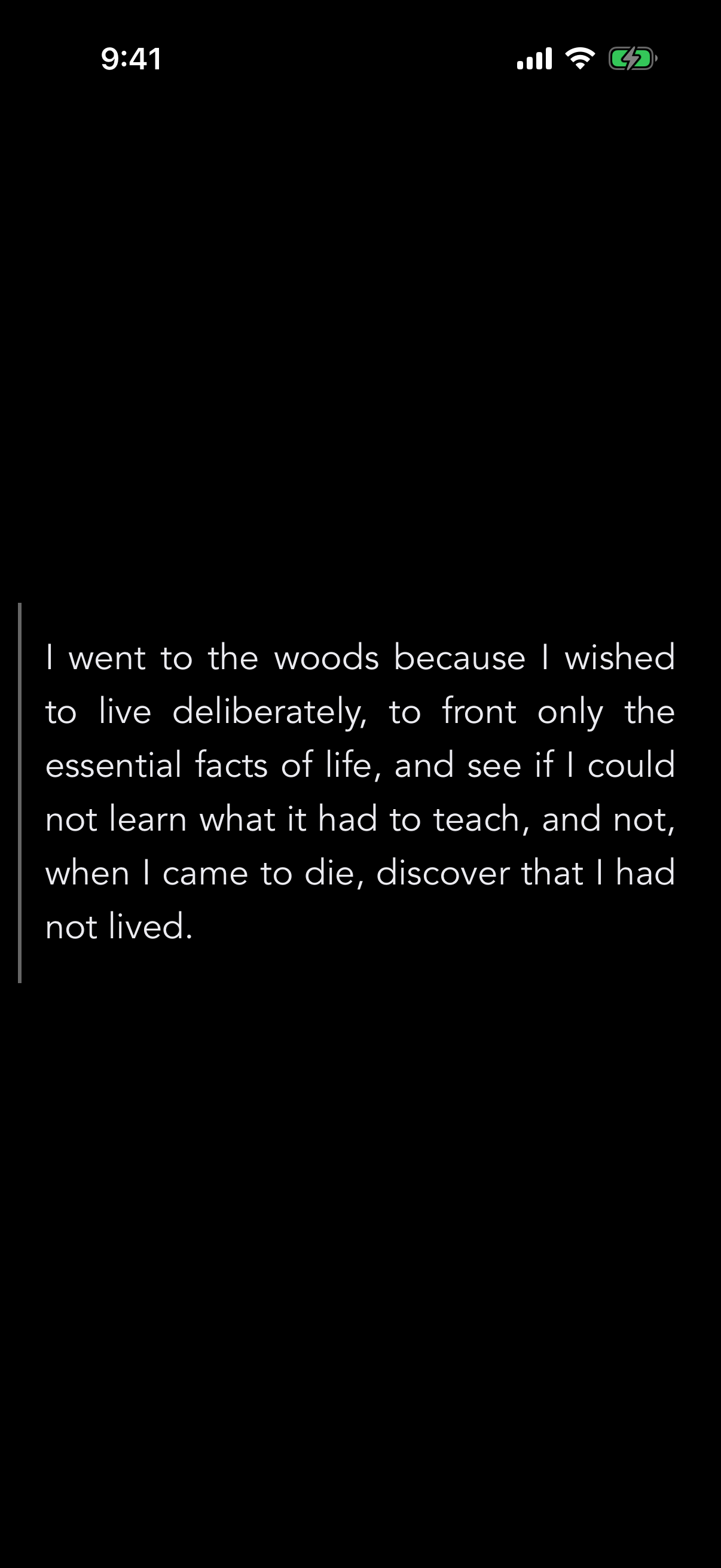
Open a book on a screen and you are usually handed a wall, a full page of text with margins and menus and a scrollbar, all at once. IO does the opposite — one paragraph, alone, full-screen, advanced at your pace. It can look like a design flourish, but it is really an argument about attention, and most of the argument is settled science.
The cluttered page
A page asks your eyes to do two jobs at once.
When you face a dense page, your attention has to manage visual complexity — where the lines break, where you are, what else is on screen — at the same time as it parses meaning. Cognitive load theory calls the first job “extraneous” load, mental effort spent on how material is arranged rather than on the material itself. Its founding studies showed that when readers must mentally stitch together content split across a display, the stitching is wasted effort that measurably hurts learning.[1] The theory’s core premise is that working memory is sharply limited, so anything you can remove from the “how it’s presented” column frees capacity for the “what it means” column.[2]
The corollary is the coherence principle, which holds that stripping out interesting-but-irrelevant material improves understanding. A meta-analysis of dozens of studies found that adding such “seductive details” reliably hurt learning.[3] Even the shape of the text block matters. Reviews of on-screen reading identify characters-per-line as a critical variable for legibility,[4] with a long-standing rule of thumb that lines should not run much past seventy characters — about fifty-five on a screen — because over-long or over-short lines disrupt the eye’s normal sweep.[5] A single paragraph, set to a deliberate measure on an otherwise empty screen, is the page with the second job removed.
One thing at a time
What happens when the noise is gone.
Presenting material in small, reader-paced units is one of the better-replicated findings in the science of instruction. In controlled experiments, people understood a fast narrated animation more deeply when it was broken into short segments they advanced themselves than when it played as one continuous stream — even a sliver of control over pacing helped.[6] A meta-analysis of dozens of studies confirmed this “segmenting effect,” with meaningful, learner-paced chunks giving a small-to-medium boost to retention and transfer and lowering cognitive load.[7] The principle is canonical enough to have a name — Mayer’s segmenting principle — and a mechanism. A self-paced chunk gives the mind time to finish one idea before the next arrives.[8]
The contrast case is the endless scroll. When the same complex text was read in a scrolling format versus a fixed one, comprehension fell — and the penalty was heaviest for readers with less working-memory capacity, because the constant act of scrolling adds a cost on top of reading.[9] A paragraph that simply waits for you, then yields to the next on a deliberate gesture, spends none of that budget on keeping your place.
The honest caveat
This is the opposite of speed reading.
It would be easy to mistake “one unit at a time” for the word-flashing speed-reading apps, and the distinction matters, because the research on those is damning. The major review of reading science concludes there is an unavoidable trade-off between speed and comprehension — the bottleneck is cognitive, not how fast the eyes can move — and it singles out apps that flash words one at a time for blocking the re-reading that repairs understanding.[10] The reason cuts to the heart of it. Skilled reading depends on regressions, the small backward glances that make up a tenth or more of eye movements. When researchers used a mask that erased each word the instant the eyes passed it — making look-backs impossible, exactly as word-flashing does — comprehension collapsed to near chance.[11]
Direct tests of the apps bear this out. Ordinary reading beats rapid-flash presentation on comprehension,[12] and flashing prose through a single point lowered literal comprehension by suppressing both peripheral preview and the ability to re-read.[13] The thing those tools destroy is reader control — the freedom to slow down, linger, and look back, which the foundational eye-movement research shows is not waste but the normal machinery of understanding.[14]
The point is to give your eyes less to fight, and full permission to look back — not to move them faster.
That is the line IO holds. Vertical reading removes the clutter that competes with meaning and leaves your control alone. The pace stays yours, and so does the sentence above, any time you want it back. The result is calm rather than fast — and calm, the evidence suggests, is the condition under which a paragraph actually lands.
References
Every empirical claim above links to its source. The boundaries matter too. Much of the segmenting evidence comes from multimedia learning rather than plain prose, and several findings are single lab studies. We flag those rather than rounding them up.
-
Chandler & Sweller (1991) theory
Cognitive load theory and the format of instruction. Cognition and Instruction, 8(4).
A foundational cognitive-load study: when readers must mentally integrate material split across a display, holding one piece in mind while hunting for the other is wasted “extraneous” effort that hurts learning; consolidating it into one view helps. (Instructional/diagram contexts, modest samples.)
View source ↗ -
Sweller, van Merriënboer & Paas (2019) review
Cognitive architecture and instructional design: 20 years later. Educational Psychology Review, 31(2).
The originators’ synthesis of cognitive load theory: new information must pass through a sharply limited working memory, so good design cuts “extraneous” load — the effort caused by how material is presented — to free capacity for understanding. (A theoretical synthesis; the reading-interface application is a reasonable extension.)
View source ↗ -
Sundararajan & Adesope (2020) meta analysis
Keep it coherent: A meta-analysis of the seductive details effect. Educational Psychology Review, 32(3).
Pooling 68 effect sizes, adding interesting-but-irrelevant details reliably hurt learning (Hedges’ g ≈ −0.33) — empirical support for Mayer’s coherence principle that stripping out extraneous material aids focus.
View source ↗ -
Dyson (2004) review
How physical text layout affects reading from screen. Behaviour & Information Technology, 23(6).
A review of on-screen text layout concluding that characters-per-line is the critical variable for line length. It deliberately prescribes no single “optimal” width, noting the best line length can depend on whether you measure reading speed or comprehension.
View source ↗ -
Mayer & Chandler (2001) rct
When learning is just a click away: Does simple user interaction foster deeper understanding of multimedia messages?. Journal of Educational Psychology, 93(2).
Students understood a narrated animation more deeply when it was broken into ~16 short, self-advanced segments than when it played as one continuous unit — even minimal control over pacing helped on transfer tests. (Fast-paced multimedia for novices, not running prose.)
View source ↗ -
Rey, Beege, Nebel, Wirzberger, Schmitt & Schneider (2019) meta analysis
A meta-analysis of the segmenting effect. Educational Psychology Review, 31(2).
Across 56 investigations, presenting instruction in meaningful, learner-paced segments gave a small-to-medium boost to retention and transfer and lowered cognitive load. (Evidence is from multimedia learning, not plain-text reading; gains vary by design and learner.)
View source ↗ -
Mayer (2009) book
Multimedia learning (2nd ed.) — The segmenting principle. Cambridge University Press.
Mayer’s canonical “segmenting principle”: people learn better from user-paced segments than from one continuous stream, because learner-controlled chunks give the mind time to finish one idea before the next arrives. (A design heuristic with documented boundary conditions.)
View source ↗ -
Sanchez & Wiley (2009) observational
To scroll or not to scroll: Scrolling, working memory capacity, and comprehending complex texts. Human Factors, 51(5).
Reading a long, complex text in a scrolling format produced worse comprehension than a fixed/paged format — and the penalty fell hardest on readers lower in working-memory capacity, because constant scrolling adds a cognitive cost on top of reading. (Desktop lab study, college students.)
View source ↗ -
Rayner, Schotter, Masson, Potter & Treiman (2016) review
So much to read, so little time: How do we read, and can speed reading help?. Psychological Science in the Public Interest, 17(1).
A major review concluding there is an unavoidable trade-off between reading speed and comprehension: the limit is mostly cognitive — identifying words and parsing language — not how fast the eyes can move. It specifically faults word-flashing speed-reading apps, since they block the re-reading that repairs understanding.
View source ↗ -
Schotter, Tran & Rayner (2014) eye tracking
Don’t believe what you read (only once): Comprehension is supported by regressions during reading. Psychological Science, 25(6).
When a “trailing mask” blanked each word the instant the eyes passed it — making look-backs impossible, exactly as one-word-at-a-time presentation does — comprehension fell to near chance, versus about 75% with normal reading. The drop was not limited to tricky sentences, so re-reading supports everyday understanding. (One lab study of isolated sentences.)
View source ↗ -
Acklin & Papesh (2017) observational
Modern speed-reading apps do not foster reading comprehension. The American Journal of Psychology, 130(2).
Ordinary static-text reading beat RSVP speed-reading — words flashed one at a time at 700 and 1,000 wpm — on comprehension across easy and hard texts. Flashing words to read fast reduced understanding relative to normal reading. (A single focused lab study.)
View source ↗ -
Benedetto, Carbone, Pedrotti, Le Fevre, Yahia Bey & Baccino (2015) eye tracking
Rapid serial visual presentation in reading: The case of Spritz. Computers in Human Behavior, 45.
Reading with the Spritz word-flasher lowered literal comprehension versus normal reading (inferential comprehension was unaffected), which the authors attribute to suppressing parafoveal preview and the ability to re-read. (Modest sample, a single app.)
View source ↗ -
Rayner (1998) review
Eye movements in reading and information processing: 20 years of research. Psychological Bulletin, 124(3).
The foundational review of how the eyes actually read: short fixations (~200–250 ms) punctuated by jumps (saccades) and occasional regressions — backward look-backs, about 10–15% of movements. The pauses and look-backs track moment-to-moment comprehension; reading is a stop-and-go process, not a smooth glide.
View source ↗
← All Posts